Days of the Week and Months Activities: A Playful, Print-Ready Foundation for Early Learning
Teaching young children the days of the week and months of the year is more than memorization—it’s about building time awareness, sequencing skills, and foundational literacy. Days of the Week and Months Activities is a thoughtfully designed, ready-to-use educational coloring book crafted specifically for preschoolers, toddlers, and early elementary learners. It transforms abstract calendar concepts into joyful, hands-on experiences—blending art, language, motor skill development, and cognitive growth in one cohesive resource.
Many educators and caregivers face familiar challenges: short attention spans, inconsistent retention of temporal vocabulary, difficulty distinguishing similar-sounding names (like “Thursday” and “Tuesday”), or frustration when tracing unfamiliar month spellings. Traditional flashcards or rote repetition often fall short for visual, kinesthetic, and emerging writers. That’s where Days of the Week and Months Activities steps in—not as a quick fix, but as a sustainable, year-round learning companion.
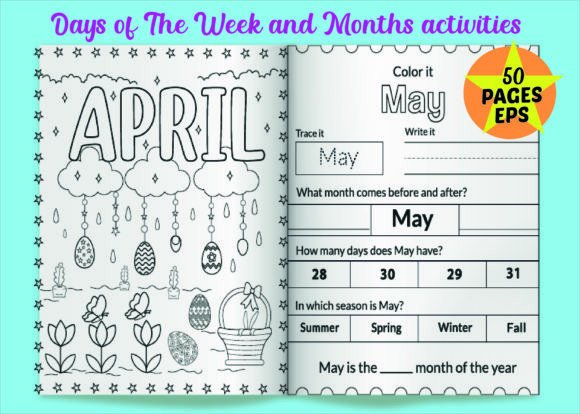
This 11-page, 8.5 x 11-inch print-ready PDF meets those needs head-on. Each page features a bold, child-friendly illustration paired with the full written name—seven unique designs for Monday through Sunday, and twelve distinct scenes for January through December. Every design invites coloring, tracing, naming, and discussion. The result? A tactile, multisensory pathway to mastery that supports diverse learning styles without overwhelming little learners.
For homeschooling families, this resource serves as a flexible anchor in daily routines—use Monday’s page each Monday morning, revisit February during winter-themed lessons, or integrate seasonal drawings into science or weather units. Preschool teachers appreciate how easily it fits into circle time, fine motor centers, or take-home folders. And because it’s designed for repeated use across seasons, it grows with the child: toddlers color freely, kindergarteners trace letters, and first graders begin writing independently—all on the same high-quality pages.
The practical outcomes are clear and measurable. Children using Days of the Week and Months Activities regularly show improved recall of weekday order, stronger letter formation habits, increased confidence in verbalizing calendar vocabulary, and heightened engagement with time-based questions (“What day is tomorrow?” “Which month comes after April?”). Teachers report fewer “I don’t know” responses—and more spontaneous connections (“My birthday is in June!” “We go to the park every Saturday!”).
What makes this resource especially effective is its intentional balance of structure and creativity. Each day and month illustration includes subtle visual cues—a sun rising for Monday, falling leaves for October, snowflakes for December—that reinforce meaning beyond the word itself. These cues support English Language Learners and neurodiverse students by linking vocabulary to concrete, relatable imagery. Meanwhile, the clean, uncluttered layout minimizes distraction and maximizes focus—critical for developing attention regulation.
Implementation is effortless. No prep required. Just download, print, and go. The high-resolution files include 50 PNGs and 50 JPGs for digital learning platforms or interactive whiteboards, plus 50 EPS vector files for custom edits or classroom signage. Whether you’re creating a laminated weekly chart, designing a bulletin board, or building a themed unit study, the assets adapt seamlessly. And because the PDF is KDP-optimized—print-ready, bleed-free, and CMYK-safe—it’s ideal for self-publishing your own classroom series or supplemental curriculum.
Different users approach Days of the Week and Months Activities in ways that reflect their goals. A busy parent might use one page per week, pairing coloring with a simple conversation: “Today is Wednesday. What did we do yesterday? What will we do tomorrow?” A preschool director may incorporate pages into a “Calendar Corner,” rotating illustrations monthly to build anticipation and routine. A special education specialist could isolate specific days or months for targeted practice, using the tracing lines to scaffold handwriting development. Even math teachers find value—using the sequence of days to introduce patterns, or comparing month lengths to explore counting, sorting, and early data concepts.
It’s also worth noting how this resource supports long-term learning—not just for the current school year, but across developmental stages. The same July page used for coloring at age three becomes a tracing exercise at four, a spelling activity at five, and a journal prompt (“What do you love about summer?”) at six. That versatility means Days of the Week and Months Activities isn’t discarded after a lesson—it stays relevant, evolving alongside the child’s growing abilities. It’s not disposable; it’s durable. Not static; it’s responsive.
When selecting early learning materials, quality matters—especially for print resources. This workbook delivers crisp, professional-grade line art optimized for both home printers and commercial presses. Thick outlines ensure clarity even when photocopied, and generous spacing around text prevents crowding—supporting emerging writers who need room to form letters confidently. There are no tiny details that frustrate small hands, no ambiguous clipart, and no outdated stereotypes. Instead, inclusive, cheerful, and seasonally authentic artwork invites curiosity and joy.
If you're looking for more than just worksheets—if you want a tool that nurtures patience, builds routine, sparks conversation, and celebrates progress—one page at a time—Days of the Week and Months Activities delivers. It meets children where they are: curious, creative, and eager to make sense of their world. And it meets adults where they need to be: supported, efficient, and empowered with a resource that works as hard as they do.
So whether you're curating a preschool curriculum, assembling a homeschool toolkit, designing a back-to-school packet, or preparing for toddler storytime, this collection offers more than repetition. It offers rhythm. It offers recognition. It offers readiness—for reading, writing, thinking, and growing. All year long.